Hello Humans!
This time, I’d like to delve into the artistic statement how to write it, what it should contain, or how to improve it.
In this blog:
- What is an artistic statement?
- What is it for?
- What elements should every artistic statement have?
- Tips
- History
- Does every artist need one?
- In conclusion
What is an artistic statement?
An artistic statement is a short text in which the artist themselves explains why and for what purpose they create.
It is a kind of manifesto, mission, or credo of your work. It doesn’t describe what is literally visible in a painting or sculpture, but explains the ideas, emotions, and questions that drive you to work.
You can think of it as a bridge between you and the viewer/curator: the viewer looks at your work, and the statement gives them the key to its intellectual and emotional interpretation.
What is it not?
- It is not a biography. You don’t list dates, schools, awards, or your place of birth there. That’s what a CV is for.
- It is not an instruction manual. You are not explaining to the viewer what they should feel. You are simply showing them your starting point.
- It is not a technical description. It’s not about the fact that you use oil on canvas, unless the material is a carrier of your idea.
For yourself: a well-written statement helps you verbalize what you may have only felt intuitively until now.
Put simply: An artistic statement is the answer to the question: “What is your art really about?”
Generally speaking, an artistic statement is a summary of what we create, why, and where our artistic self comes from.

2. What is it for?
It is your mental compass, before the statement reaches anyone else, it is an invaluable tool for you. The very process of writing it forces you to crystallize your thoughts:
It reveals coherence: We often create intuitively, jumping between topics. The statement forces you to find the thread that connects all your works even those seemingly different at first glance. You realize that you have actually been circling one deep problem for years, just in different guises.
Decision-making: When you are at a crossroads (“does this new idea fit my practice?”), a well-formulated statement acts as a filter. It allows you to reject projects that are only aesthetically pleasing but empty of meaning, and focus on what is truly important.Preparation for conversation: It is your rehearsed answer to the most important questions during an opening, interview, or meeting with a gallerist. Instead of stammering and improvising, you have a solid, thoughtful core in your head from which you can bounce off in conversation.
It is an interpretative key (for the viewer)Contemporary art often requires context. The statement doesn’t impose a single correct interpretation but opens the door. It serves as:
A translator of ideas: It translates abstract visual form into the language of emotions and questions. A viewer who feels lost gets a hint: “Ah, this disorientation I feel in this installation is intentional, because the artist is exploring the theme of migration and loss of orientation in space.”An experience deepener: It acts like a minefield for the viewer’s own thoughts. A conscious viewer can enter into a dialogue with your work, referring to the questions you have posed, instead of just summing it up as “nice/ugly.” It makes contact with art an intellectual adventure, not just aesthetic consumption.
It is a professional calling card (in the art world)This is the most pragmatic application. In professional circulation, no one has time for guesswork.
The statement is: A filter for the curator/gallerist: They receive dozens of portfolios daily. After the title and images, they read the statement. They are looking for proof that you are not just a skilled craftsman, but a conscious artist with your own, thoughtful language. If your works are mysterious and the statement is trivial you’re out. If the statement is deep and the works gain context you are invited for further discussion.The core of an application (grants/scholarships/residencies): Jurors assess not only the final works but, above all, your motivation and potential.
The statement answers the questions: “Does this artist know where they are going? Are they capable of development? Is what they are doing socially/artistically significant?” A good statement proves that investing in you makes sense.Material for the press and social media: Journalists and content creators literally cut quotes from it. It’s easier for them to write about you when you give them ready-made, attractive language.
It is a narrative bridge (for your entire practice)The statement connects individual cycles and series into one fascinating story about the artist:
In short: an artistic statement is a tool for thinking, communication, and building your position. If the work is the body of your art, then the statement is its soul, which makes that body come alive in contact with others.
3. Elements every professional artistic statement must contain:
A strong opening (“Elevator Pitch”)The first 2–3 sentences are the essence of everything. You only have a moment to intrigue the curator, gallerist, or juror. You must immediately answer the question: What do you do as an artist and what distinguishes your practice?
What to include: The main medium(s), the key theme, and the character of your work.
Main themes and guiding ideas (“What” and “Why”)This is the theoretical heart of your statement. Describe what ideas, questions, or problems drive your creativity. Don’t list all the themes focus on 2–3 key concepts that run through your entire practice.
Materials, media, and technique (“How”)Justify why you use these particular means of expression and not others. The material cannot be accidental it must stem from the idea. Describe the physical dimension of your work.
Creative process and methodology Here you give a glimpse behind the scenes. Describe how you work is it intuitive, research-based, collective, based on archives, or does it result from careful observation of everyday life? This builds credibility and shows your creative self-awareness.
Context and inspirations (References)Succinctly indicate the tradition or discourse with which you are in dialogue. This proves you understand your place in the art world. It doesn’t have to be a list of names it’s enough to mention the philosophical current, sociological phenomenon, or art history movement you refer to or critique.
Goal and impact on the viewer What effect do you want to have on the audience? What is the function of your art? Is it meant to provoke discussion, cause discomfort, give solace, change the perception of space?
What should NOT be there?
- Biography: That’s what a CV is for. Don’t write “I was born in… I graduated from…” in an artistic statement.
- Empty words and jargon: Avoid trendy, meaningless phrases (“I explore the boundaries of the human condition in interdisciplinary dialogue”).
- Describing what is visible: If the viewer can see that the painting is blue, don’t write “I mainly use blue,” unless you are explaining the meaning of that blue.
4. Tips.
Writing an artistic statement is a bit like doing a self-portrait with words it has to be honest, accurate, and show your unique face, not a jumble of someone else’s poses. Here is a set of concrete, workshop-style tips that will help you go from a blank page to a text you will be proud of.
I look at my works from the last 2 years. What is the one common denominator that connects them?What angers, terrifies, or delights me in the world so much that I MUST process it into art?What moment in the creative process is the most important for me?If I were to describe my art with one strange adjective, what would it be?How do I want the viewer to feel after contact with my work?
From these answers, you will extract specific keywords that will become the skeleton of your text.
Process: Write three, throw away two. Don’t get attached to the first version. It’s just a prototype.
The ultimate test: “Is this mine?” Ask yourself three check questions:
- Would my mother, who doesn’t know contemporary art, understand the core of what I want to convey?
- Could anyone else in the world sign their name under this text?
- Does this text fit the works I am creating now, or those from 5 years ago?
Remember, a good artistic statement is not a competition essay, but an invitation into your world. When writing it, don’t try to prove how smart you are. Try to talk about what makes your heart beat faster when you enter the studio. That’s all, and that’s everything.
5. History
The pure form of the “artistic statement” as we know it today (a concise text under a portfolio) is mainly an invention of the late 20th century, driven by grant bureaucracy and art education.
Historical artists rarely wrote anything titled “Artistic Statement.” They did something else, though they created manifestos, letters to friends, fiery essays, and declarations that are the essence of an artistic credo and from which we can draw generously.
Letters full of obsession – Vincent van Gogh
This was not an official text for a gallery. These were intimate, at times chaotic letters to his brother Theo. And yet, you will not find a better insight into the “why” of an artist. A scream from the front page of a newspaper
The Futurist Manifesto
(Filippo Tommaso Marinetti, 1909)This was no longer a letter. Marinetti paid to have his text published on the front page of the Parisian “Le Figaro.” This is an example of how a statement can become a tool of shock and myth-building for a movement, not just a single artist. A manifesto for painting you can hear
Wassily Kandinsky
Kandinsky was a theoretician. His book Concerning the Spiritual in Art (1911) is an extensive statement, but its essence is terrifyingly clear. The bible of conceptual art
Sol LeWitt
His “Paragraphs on Conceptual Art” (1967) and “Sentences on Conceptual Art” (1969) are probably the most frequently cited artistic credo of the 20th century. It is a dry, dogmatic, intellectual manifesto in the form of numbered sentences.Personal anger changes art.
6. Does every artist need one?
No, not every artist needs a written artistic statement. However, absolutely every artist needs its spirit that is, a deep, thoughtful answer to the question: “Why do I do what I do?”
Whether you pour this answer onto paper depends solely on your path and your relationship to the art world. Let’s break it down by situation.
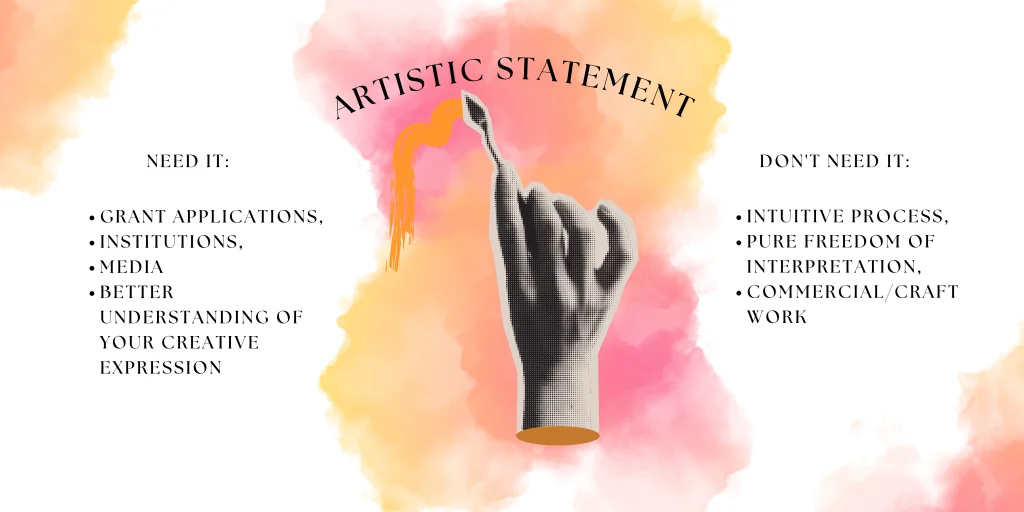
When do you NOT need a formal statement? (And that is completely OK)
There are artists for whom writing manifestos defeats the purpose of their practice or is even a denial of their philosophy.
If your philosophy is complete freedom of interpretation:If you are a purely intuitive or “process-based” artist:If you operate in a purely commercial, decorative, or craft-based model:When you are in a stage of searching, not defining:
In these cases, you can calmly dismiss the obligation of having a statement. You are an artist not through paper, but through action.
When does a statement become NECESSARY? (Pragmatic reality)
Here we enter the world of institutions. There are situations where, without this document, you simply won’t cross the threshold:
Applications for grants, scholarships, residencies, galleries, and art academies (especially a PhD!):Exhibitions in institutions and galleries:Communication with critics and media:
To sum up: If the question about a statement is a question about an obligation to the art system no, not everyone needs one. If it is a question about self-awareness and respect for your own work yes, everyone needs its essence, even if it’s written on a scrap of napkin in your pocket. You need to be able to tell yourself why tomorrow you will walk into the studio again.
7. In conclusion
These are the basics about writing an artistic statement. It is difficult, so don’t worry if it doesn’t work out for you. I am refining my own statement because it’s no simple task to summarize your artistic self in a few sentences, but once you manage to do it, it will even become a little easier for you to create.