Hello artists!
I think each of us has a whole stack of started and never finished works. And has also struggled with pieces that are ‘on hold’ indefinitely. This is usually quite controversial; everyone expects works now and judges our slow struggles.
That’s why today I will write about why it’s actually good to let a work ‘rest.’
In this Blog:
- Why do we abandon our works?
- Slow development in art: why sometimes less is more?
- Historical examples
- Time in the name of the true process and its benefits
- “The Trap of Incompletion”: when slowness becomes dangerous and what to do about it?
Why do we abandon our works?
Perhaps let’s start from the very beginning: why do we actually abandon our works and need time to finish them?
I’ll say right away that this phenomenon is as common as it is poorly understood. In studios all over the world lie canvases, sculptures, sketches, and other works waiting to be finished, sometimes longer than the artist themselves lives.
So you are not alone; we all do this.
Why does this happen? Here are the key reasons:
1. Mismatch between technique and vision
As artists, we imagine our work in a specific way. However, when we start creating it, it often turns out that it doesn’t come out as we imagined.
We feel we lack enough skill, that we made a creative mistake somewhere. So we set it aside and wait until we acquire new techniques/skills/materials to do it more in line with the form we imagined.
2. Evolution of artistic identity
Style changes, and a work started in one aesthetic no longer fits the current creative path. I think every one of us artists has at some point thought about how much our style has changed. In this context, our earlier started work is an interesting document but difficult to continue in our current artistic language. The idea was good, we know that, but finishing it? It doesn’t fit the current form, so the work gets abandoned.
3. Perfectionism vs. vision
Who among us hasn’t imagined a work in a specific form? The imagination was wonderful, but the execution?
Seeing a vision that isn’t developing as it should wounds our artistic visions.
So, instead of compromising our vision or disappointing our inner self, we decide to abandon the work indefinitely, believing that one day it will surely succeed.
4. Emotional burden
Some works are so saturated with difficult emotions (grief, love, trauma) that each creative session becomes a psychological burden. We then need a time distance to return to the topic without the paralyzing load of feelings. We certainly all understand that art is governed by emotions, so sometimes we don’t abandon works out of laziness or boredom, but out of overload.
Slow development in art: why sometimes less is more?
In a world that often demands immediacy from us, the idea of slow development in art may seem controversial.
Especially since we are often judged through this prism; we are expected to finish works and not waste time.
And yet, many outstanding works and artistic careers developed precisely at the pace of patience. Here’s why a slow pace of creation is sometimes the most effective artistic strategy.
Depth instead of surface
A slow process allows us to create extraordinary creations full of emotion. Time can have many drawbacks, but one advantage is that we can look closely at details, develop our idea, and establish a deep connection with it.
To digest ideas, concepts mature, evolve, revealing their deeper layers over time. Often our idea evolves; time allows us to mature details we didn’t perceive before.
To experiment without pressure. A slow pace gives space for mistakes, which often lead to breakthrough discoveries. Nothing develops us more than giving ourselves time and deeply contemplating our work.
To build authenticity. The work becomes more personal, less reactive to fleeting trends. Thanks to dedicating time to your artworks, it allows you to do what we always try to do: put our heart and soul into our works.
Historical examples
- Leonardo da Vinci painted the “Mona Lisa” for about 4 years, constantly perfecting the technique.
- J.R.R. Tolkien wrote “The Lord of the Rings” over 12 years, creating an entire universe.
- Artists like Zdzisław Beksiński or Magdalena Abakanowicz developed their characteristic styles over decades.
- Michelangelo left about 2/3 of his sculptures “unfinished” – today we consider this a conscious artistic decision.
- Paul Cézanne often abandoned landscapes, returning to them years later – his series of Mount Sainte-Victoire was created over a decade.
- Polish composer Karol Szymanowski worked on the opera “King Roger” with interruptions for 7 years.
As you can see, many great artists and creators have this in common. Abandoning works for a longer time.
Time in the name of the true process and its benefits
The creative process requires time; we all know that, but the fact that it takes time doesn’t mean it’s bad…
Physical time: The creative process usually takes long hours, regardless of whether we are creating sculptures, paintings, installations, designs… Any manual creative work requires time, and that’s not a bad thing.
A long process allows us to understand our work better, refine creative details, develop the idea into something bigger, and also, for example, create more content so others better understand what our creative process looks like.
Psychological time: the period in which an idea develops in the subconscious. This is the period when we think, consider, and better understand our emotionality related to our creative process. This is an extremely important time because it is precisely the moment when we better understand our artistic identity.Emotional time: the distance needed to evaluate work without fresh bias.Experimental time: allowing oneself to go down blind alleys that teach more than straightforward paths.
“The Trap of Incompletion”: when slowness becomes dangerous and what to do about it?
However, we all know that moment when time doesn’t develop but rather impairs. Unfinished works lie around and decay; ideas instead of developing are forgotten…
I won’t pretend I haven’t fallen into this trap myself because, of course, I have unfinished works, but I will present you with a few things that have helped me at least a bit, and I hope they help you too.
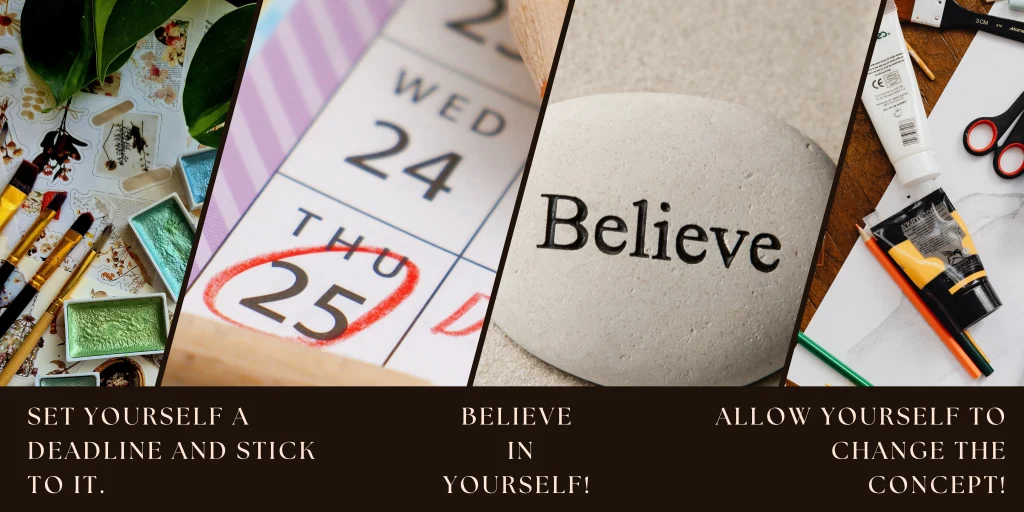
- Set yourself a deadline and stick to it.
It sounds simple, but it gives a lot. When somewhere in our subconscious we know we have to finish something by a specific date, there’s a higher probability we’ll sit down to our work again to make it.
Of course, I don’t mean introducing stress and giving ourselves unrealistic time, but it’s good to have even in our calendar noted when exactly we want to finish our work.
We can also divide it into specific stages if the end is too vast.
For example: Give yourself a week to finish the sketch/concept, then a month for preliminary execution, then another month for finishing.
The stages depend on what we are creating and how many such deadlines we want to set for ourselves.
- Allow yourself to change the concept!
This was often my big problem: I came up with something in a specific form and wouldn’t allow myself to change it even if a new idea appealed to me more.
Often, this is our problem: the idea evolved from the original form, but the work we started was prepared for the old form.
So instead of changing it? We leave it with the idea that we liked before but no longer speaks to us.
My advice? Let the idea evolve, even if it forces us to change certain things, to do something again… It is better to work more on the work, change the concept in the meantime, than to abandon the work and leave it like that.
- Believe in yourself!
Yes, ladies and gentlemen, people and creatures, self-belief is often our biggest problem, even if we are not aware of it.
Why?
Well, when we create our work, we often struggle with thoughts that suggest, for example, that we won’t manage, that our skills are too low, that the work looks worse than the concept.
The solution? Fighting with ourselves, and I know it’s easier said than done.
But let’s remember that even if our work is not perfect, it is wonderful because it is ours, it is worth creating, even if it’s not exactly as we imagined it.
It is better to finish the work, allow ourselves to learn from it, and even redo it over time, than to abandon it as a testament to our doubts.
I hope this helps you in creating your works and that you will now look differently at your unfinished works.
Please tell me about your creations—perhaps you’ll revisit one of them again?
Have a wonderful time artistic humans and creatures!
Go create ☕
No Responses